
Latino voters who supported President Donald Trump in 2024 differ from those who supported Democratic candidate Kamala Harris not only in their political views, but also in how central their Latino identity is to their lives. Across multiple measures, Trump voters are less likely to see their Latino background as central to who they are or as shaping their life experiences. By contrast, Harris voters see their identity as important to who they are and as consequential in their lives.
In the 2024 presidential election, nearly half of Latino voters backed Trump, his highest level of support from the group in his three presidential runs, according to a Pew Research Center validated voter analysis.
In addition to viewing Hispanic identity as less important in their lives, Hispanic Trump voters are more likely than Hispanic Harris voters to say:
- Being Hispanic neither helps nor hurts their ability to get ahead in the United States.
- What happens to other U.S. Hispanics has little impact on their own lives.
- They feel little responsibility to look out for other Hispanics.
And Hispanic Trump voters are twice as likely as Latino Harris voters to most often describe themselves as “American” rather than as Hispanic, or by their family’s place of origin label (such as Cuban or Mexican).
These differences hold even after controlling for factors such as immigrant generation, income, religion, age, gender, political affiliation and the state where they live.
Differences in views of identity also exist between Latino Democrats and Latino Republicans, though to a lesser degree than those by 2024 vote choice.
Although many Hispanic Trump voters identify as Republicans, our analysis of 2024 validated voters shows the two groups are not the same – a distinction that also applies to Hispanic Harris voters and Hispanic Democrats. Even as Trump made gains among Hispanic voters from 2016 to 2024, the partisan composition of Hispanic adults changed little over the same period.
In this analysis, 2024 vote choice and party identification are examined side by side because each sheds light on how Hispanics think about identity, belonging and opportunity in the U.S.
Taken together, these findings suggest that Hispanic voters are not only divided politically, but also in how much their Hispanic background shapes how they see themselves and their place in U.S. society.
The October 2025 survey was conducted before subsequent changes in immigration enforcement and the economy, which may shape how U.S. Hispanics think about identity. Other questions from the same survey – including those about Hispanics’ views of the Trump administration and its immigration and economic policies – were published in November 2025.
This analysis is part of a larger study about U.S. Latino identity. For a summary of the main findings, visit “U.S. Hispanics are divided on whether their identity helps or hurts them in America.”
2024 vote choice, partisanship and the impact of being Latino in America
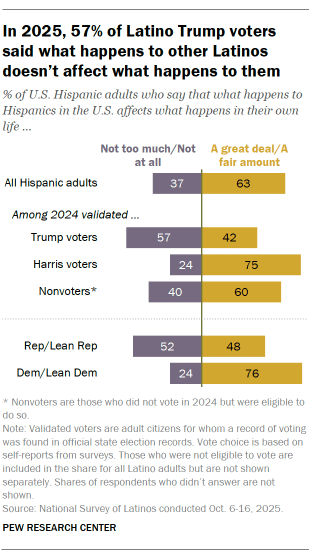
A majority (57%) of Latino Trump voters say that what happens to Latinos in the U.S. affects what happens in their own lives not too much or not at all. By contrast, 75% of Latino Harris voters say that what happens to Latinos in the U.S. affects what happens in their own lives a great deal or a fair amount, according to the October survey.
Latino Trump voters also feel less obligated than Harris voters to look out for other U.S. Latinos. Some 61% Latinos who voted for Trump in 2024 say they never or not too often feel a sense of responsibility to look out for other Latinos in the U.S. By contrast, 20% of Harris voters say the same, while 48% say they feel this responsibility extremely or very often.
There are similar patterns by partisan identity: Hispanics who are Republicans and Republican-leaning independents are less likely than Hispanic Democrats and Democratic leaners to say that what happens to other Hispanics in the U.S. affects what happens to them personally (48% vs. 76%, respectively), and less likely to say that they often feel a sense of responsibility to look out for other Hispanics (21% vs. 47%).
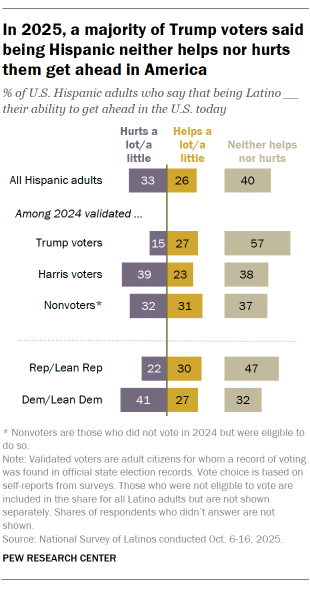
There also are political divides on the extent to which Hispanic identity in the U.S. carries a cost or creates opportunity.
A majority of Hispanic Trump voters (57%) say that being Hispanic neither helps nor hurts their ability to get ahead in the U.S.
But among Hispanic Harris voters, 39% say being Hispanic hurts their ability to get ahead either a lot or a little, 23% say it helps a lot or a little, and 38% say it doesn’t make a difference.
When asked if they have experienced discrimination in the year prior to the October survey, 15% of Hispanic Trump voters say they were discriminated against or were treated unfairly because of their Hispanic background by someone who is not Hispanic. More than twice as many Hispanic Harris voters (39%) say the same.
Similarly, Hispanic Trump voters are less likely than Hispanic Harris voters to say they were criticized for speaking Spanish in public (11% vs. 27%), that someone told them to go back to their home country (9% vs. 23%), or that they were called offensive names because they are Latino (12% vs. 24%).
Again, there are similar patterns by partisanship, though the gaps are less pronounced. Hispanic Republicans are more likely than Hispanic Democrats to say their Hispanic identity makes no difference in their ability to get ahead in the U.S. (47% vs. 32%). And Hispanic Republicans are less likely than Hispanic Democrats to say they’ve been discriminated against or treated unfairly because of their Hispanic background by someone who is not Hispanic (40% vs. 29%).
These differences remain even after accounting for demographic factors such as age, gender, income and immigrant generation. Even so, the survey cannot show whether differences are driven by vote choice or partisanship. Other unmeasured factors — such as skin color, the racial and ethnic makeup of one’s community, how often one speaks Spanish in public, or differences in how people perceive and report discrimination — may also influence how Hispanic identity is experienced in the U.S.
Hispanic Trump voters place less emphasis on their Hispanic identity than Hispanic Harris voters do
While most Latino Harris voters (69%) say being Latino is extremely or very important to how they think about themselves, less than half of Latino Trump voters (42%) say the same. Indeed, about three-in-ten Latino Trump voters say their Latino identity not too or not at all important, and roughly a quarter say it’s somewhat important.
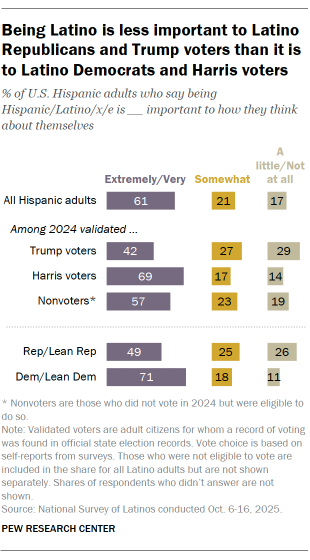
There’s a similar pattern by partisan identity: Hispanic Republicans are less likely than Hispanic Democrats to say Hispanic identity is important to how they think about themselves.
We also asked respondents which types of labels they most often use when referring to their identity in their daily lives. We offered five choices:
- Hispanic, Latino, Latinx or Latine
- Hispanic, Latino, Latinx or Latine + American (e.g., Hispanic American)
- Country of origin or heritage (e.g., Mexican)
- Country of origin or heritage + American (e.g., Mexican American)
- American
Among Latino Trump voters, American is the most common choice, with 43% in that group saying that is the label they use most often to describe themselves. Another 35% say they usually describe themselves using their country of origin or heritage – either alone or together with American.
By contrast, 54% of Latino Harris voters say they most often describe themselves using their country of origin (either alone or combined with American), while 22% say the label they use most often is American.
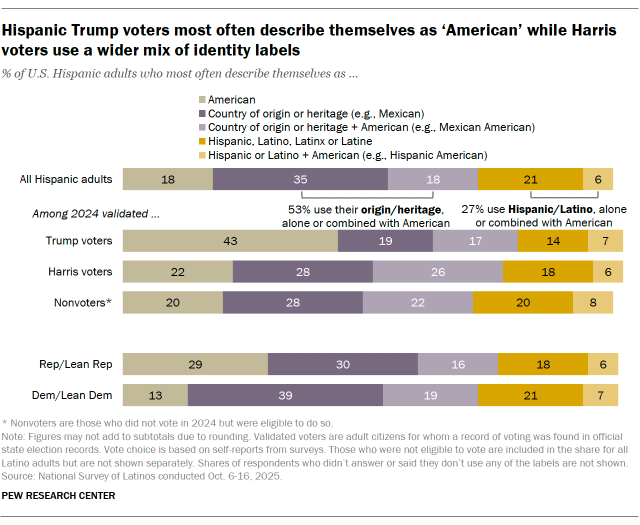
There are differences by party on this question too, though they are not as pronounced as by vote choice. For example, 29% of Hispanic Republicans refer to themselves as American alone, while a similar share (30%) refer to themselves using their country of origin or heritage (e.g., Mexican). Meanwhile, 13% of Democrats say they use American most often, while 39% use their country of origin or heritage.
On other identity questions measured in the survey, there are fewer differences between Hispanic Trump and Harris voters. Majorities in each group say they consider themselves “a typical American” (72% vs. 60%, respectively), and that they prefer the pan-ethnic label Hispanic over other pan-ethnic labels such as Latino, Latinx or Latine (64% vs. 54%). Jump to our more detailed analysis about the terms U.S. Latinos use to describe their identity.