
A fragile ceasefire is on the brink after Iran launched new missile and drone attacks on the United Arab Emirates, a key US ally.
The country’s defence ministry said on Friday that it was “dealing with missile and drone attacks originating from Iran” and that its systems were intercepting “ballistic missiles, cruise missiles, and drones”. No injuries have so far been reported.
However, president Donald Trump has insisted that the agreement with Iran was still holding after three US destroyers came under attack from missiles, drones and small boats in the Strait of Hormuz.
Though none of the vessels were hit, Washington launched retaliatory strikes on what it described as Iranian military sites, including launch positions and command centres.
Trump called Iranian leadership “lunatic”, warning Tehran that Washington will “knock them out a lot harder, and a lot more violently, in the future, if they don’t get their Deal signed, FAST!”
Iran, however, said the clashes were an “exchange of fire” after the US allegedly targeted vessels near the strait and claimed its forces had inflicted “significant damage” on American ships.
Thursday’s attacks happened as Iran was reviewing a US plan to reopen the Strait of Hormuz and end hostilities, according to multiple reports.
China confirms attack on oil tanker in Strait of Hormuz
China’s foreign ministry confirmed on Friday that an oil products tanker carrying Chinese crew was attacked in the Strait of Hormuz, and expressed deep concern about vessels affected by the ongoing conflict in the Middle East.
There are Chinese nationals aboard the vessel, but no reported crew casualties so far, foreign ministry spokesperson Lin Jian said during a regular news conference.
A Chinese-owned oil products tanker was attacked near the Strait of Hormuz on Monday, China’s Caixin reported on Thursday.
James Reynolds8 May 2026 09:15
European shares retreat as Middle East tensions flare
European shares dropped on Friday, with an escalation in clashes sending oil prices higher and dampening hopes that a diplomatic solution could be close.
Donald Trump said the ceasefire was still in effect despite forces clashing in the Gulf, with Washington awaiting a response from Tehran to its proposal to end the conflict.
The pan-European STOXX 600 fell 0.8% to 611.69 points as of 0703 GMT. Major regional markets mirrored the move, with Germany’s DAX and London’s FTSE 100 down 0.9% and 0.5%, respectively.
European equities have remained sensitive to geopolitical headlines, with the region’s energy dependence weighing on markets and raising concerns over the impact on inflation and growth. Financial markets currently price in three or more rate hikes from the European Central Bank over the next 12 months.
James Reynolds8 May 2026 09:00
Trump set to meet Xi despite Iran woes
Donald Trump is still set to meet with his Chinese counterpart Xi Jinping next week in Beijing, despite concerns around the unresolved war with Iran.
The leaders are set to meet on 14-15 May, having already pushed the date back over the conflict.
Bloomberg reports that some Chinese officials are uneasy about holding the meeting – the first visit of a US leader in a decade – before the war in Iran is resolved.
James Reynolds8 May 2026 08:26
Asian stocks fall and oil prices climb after attacks imperil the ceasefire with Iran
Asian stocks retreated and oil prices rose on Friday as the fragile ceasefire with Iran was strained by missile and drone attacks that prompted US retaliatory strikes on Iranian military facilities.
US futures rose despite the latest flaring in the conflict.
Investors are closely watching the war situation as negotiations between the US and Iran to end the war make limited progress. Tehran said Thursday that it was still examining the latest proposals from the U.S. for ending the war.
Tokyo’s Nikkei 225 fell 1.1 per cent to 62,174.12 after closing the day before at a record high of 62,833.84. It also briefly crossed the 63,000 mark for the first time during Thursday trading. SoftBank Group, one of Japan’s largest stocks, lost more than 5 per cent.
Maira Butt8 May 2026 08:00
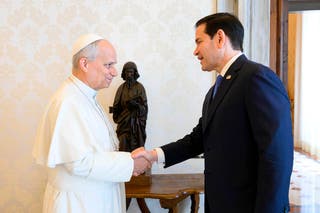
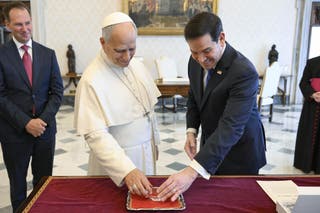
Rubio and Pope commit to stronger ties, Vatican says
US secretary of state Marco Rubio arrived at the Vatican on a fence-mending visit with Pope Leo after the US presient’s bitter tirade against the Vatican leader.
Trump’s repeated broadsides against history’s first US pope created an unprecedented back-and-forth on issues of the Iran war and peace that strained US-Holy See relations.
By the end of the visit, both the Vatican and the State Department stressed their strong bilateral ties.
But the episode nevertheless pushed Leo out of his comfort zone and onto the global stage to make zingers like the one this week, after Trump’s latest misrepresentation of his views.
Leo and Rubio “renewed the shared commitment to fostering good bilateral relations,” the Vatican said in a statement after the first meeting between the pope and a Trump cabinet official in nearly a year.
Rubio’s meeting with Leo is a sign of a “strong” relationship between the Vatican and the US, state department spokesman Tommy Pigott said.
Rubio spent two and a half hours at the Vatican before driving away in a convoy under tight security. He also met with senior Vatican officials, including top diplomat Italian Cardinal Pietro Parolin.
Shweta Sharma8 May 2026 07:31
Trump says US proposal to Iran was ‘more than a one-page offer’
Donald Trump said on Thursday that a US proposal aimed at ending the conflict with Iran was far more detailed than reports describing it as a “one-page offer”.
Speaking to reporters, Trump said the proposal included commitments that Iran would not pursue nuclear weapons and would hand over what he described as “the nuclear dust”, alongside “many other things that we want”.
“They have agreed,” Trump claimed, before adding that Iranian assurances could quickly change. “When they agree it doesn’t mean much because the next day they forgot they agreed,” he said.
Trump also suggested Washington was dealing with competing factions within Iran’s leadership, saying: “We’re dealing with different sets of leaders.”
Iran has yet to formally respond to the proposal. Iranian media reported that Tehran was still reviewing messages from the US delivered through Pakistan, which has been mediating between the two sides.
Shweta Sharma8 May 2026 07:00
Here is everything you need to know if you are just joining us.
- US president Donald Trump branded Iran’s leadership “lunatics” after three US destroyers came under attack in the Strait of Hormuz in one of the most serious confrontations since the fragile ceasefire began
- The US military said missiles, drones and small boats targeted the warships during their transit through the strait, though all attacks were intercepted and none of the destroyers were hit
- Washington later carried out retaliatory strikes on what it described as Iranian military facilities responsible for the assault, including launch sites and command centres
- Writing on Truth Social, Trump said the Iranian attackers had been “completely destroyed” and warned Tehran the US would respond “a lot harder, and a lot more violently” if a peace deal was not signed quickly
- Iran, however, described the incident as an “exchange of fire” between Iranian armed forces and the “enemy” even as Trump said the ceasefire was holding
- Iranian news agencies reported that “several explosions” were heard near the city of Bandar Abbas, while commercial sections of a pier on Qeshm Island – the largest island in the Gulf – were reportedly targeted
- Iran’s top military command alleged the US had targeted an Iranian oil tanker heading toward the strait as well as another vessel entering the waterway opposite the Emirati port of Fujairah
- Tehran said its armed forces had “immediately responded” by attacking US military vessels and claimed to have inflicted “significant damage”, though the US said none of its destroyers were hit
- Trump later insisted the ceasefire was still holding and said negotiations with Tehran continued. “It could happen any day,” he said of a potential deal, before adding, “And it might not happen”
Shweta Sharma8 May 2026 06:40
Oil prices rise as US and Iran exchange fire in Strait of Hormuz
Oil prices rose and stock markets pulled back slightly on Friday after the US and Iran exchanged fire in the Strait of Hormuz, although Asian markets remained on course for their strongest weekly performance in years on the back of an AI-driven rally.
Brent crude rose 1.3 per cent to $101.60 per barrel as the renewed Middle East hostilities unsettled markets that had spent much of the week pricing in a negotiated resolution.
Iran targeted three US destroyers with missiles, drones and small boats in the strait on Thursday, according to the US military, which said the attacks were successfully intercepted and none of the warships were damaged. Strikes were then carried out against Iranian military facilities, including launch sites and command and control centres, it claimed.
Stuti Misra8 May 2026 05:56
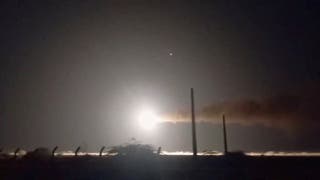
In picture: Iranian navy firing in Strait of Hormuz
A still image from a video shows the Iranian navy firing a missile at an unknown location.
Iranian news agencies reported that “several explosions” were heard near the city of Bandar Abbas, while commercial sections of a pier on Qeshm Island, the largest island in the Gulf, were reportedly targeted.
Iran’s top military command alleged the US had targeted an Iranian oil tanker heading toward the strait as well as another vessel entering the waterway opposite the Emirati port of Fujairah.
Tehran said its armed forces had “immediately responded” by attacking US military vessels and claimed to have inflicted “significant damage”, though the US said none of its destroyers were hit.
Shweta Sharma8 May 2026 05:37
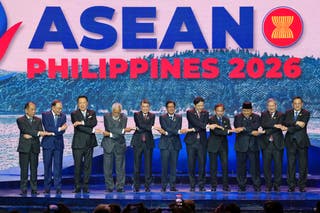
Southeast Asian leader meet in Philippines to discuss response to Iran war
Leaders of Southeast Asian countries are meeting today to discuss a coordinated response to the Middle East crisis.
The meeting of the leaders of the Association of Southeast Asian Nations is being held in Cebu, Philippines, the chair of the bloc.
They are expected to press for a harmonised strategy to ensure energy and food security in a region particularly exposed to a nearly 70-day blockade of the critical Strait of Hormuz.
In opening remarks as chair of Asean, Philippine president Ferdinand Marcos Jr said Asean was standing together to demonstrate its capacity to respond with unity and resolve, but must remain agile.
“We must ensure regional energy security and resilience,” he said.
“At a time of heightened volatility, Asean must strengthen coordination and reinforce preparedness, pursue practical collective measures to safeguard a stable energy supply and improve interconnectivity.”
The leaders are seeking to diversify suppliers and routes and developing a crisis communication protocol, but it was unclear what, if any, action might be taken.
Shweta Sharma8 May 2026 05:32